Rethinking Hands-On Touch in the Pilates Studio: A Guide
What is the actual purpose of hands-on adjustments in Pilates? What does Tactile cueing mean to a Pilates Teacher? What is the Pilates teacher hoping to accomplish for their Pilates clients with their hands-on adjustments?
In Season 7, Episode 8 of The 2 Pilates Chicks, we tackle a topic that has gained significant momentum across the movement community: appropriate tactile cueing, scope of practice, and client consent.
Some practitioners treat physical adjustments as the gold standard of effective instruction, while others avoid touching clients altogether. Our approach to instruction must evolve alongside current research in biomechanics, motor control, and trauma-informed communication. Here is why it might be time to rethink how hands-on corrections are utilized in a studio. When used with clear intention and technique, hands-on feedback provides immediate neuromuscular feedback. When overused or applied aggressively, it bypasses motor learning and compromises client independence.
Our mission as Pilates teachers is not to insert ourselves into the client’s movement or force an arbitrary aesthetic shape. It is to facilitate self-organization, safety, and authentic autonomy.
Core Definitions of Cueing Modalities
Effective movement instruction relies on three primary feedback channels. Understanding how they interact ensures touch is used as an intentional enhancement rather than an instructional crutch.
Verbal Cueing: Instructional language that directs movement trajectory, cadence, breath patterns, and spatial targets (e.g., external target cues vs. internal muscle directives).
Visual Cueing: Demonstrations, teacher body language, physical signposts, or spatial focal points that offer the brain an external model to organize around.
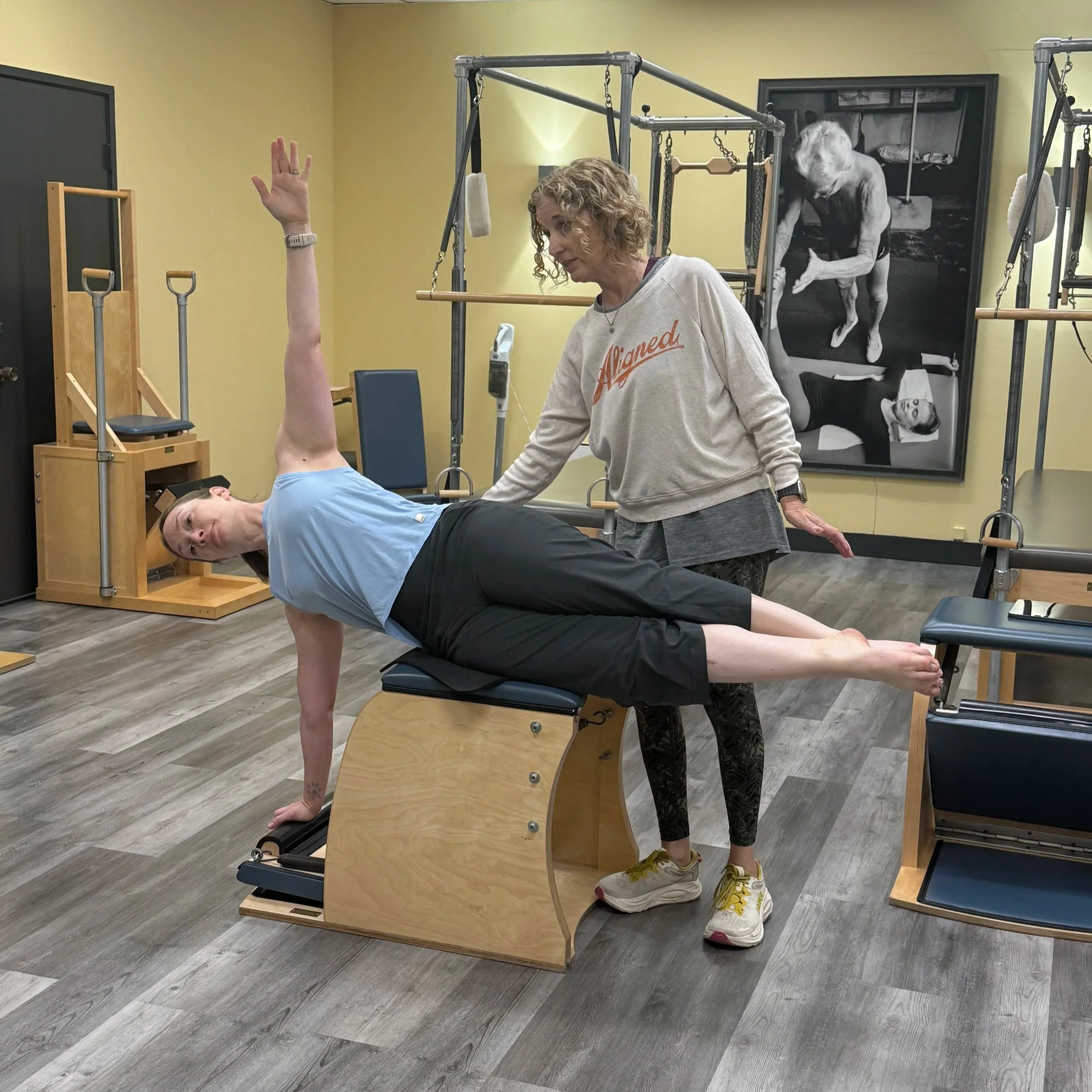
Tactile (Hands-On) Cueing: Physical contact applied by the teacher—or delivered through the Pilates apparatus—to provide direct proprioceptive data, establish boundaries, or guide direction.
The Purpose of Tactile Cueing
The primary goal of hands-on feedback is never to force a body into an aesthetic shape. Its purpose is to facilitate self-organization within the nervous system.
Enhancing Proprioceptive Awareness: Tactile input gives the brain immediate sensory data regarding where a joint or limb is located in three-dimensional space.
Establishing Active Movement Boundaries: Touch provides a tangible reference point for the client to feel end-range control, preventing hyperextension, compensatory positioning, or lack of energy through the limbs.
Facilitating Dynamic Stability: By offering a steady surface to press into or draw away from, tactile contact helps the client organize their own stabilizing muscles against external forces.
Fostering Long-Term Self-Efficacy: Purposeful touch is temporary input designed to help the client understand the movement independently, ensuring they retain autonomy once the teacher's hands are removed.
Reframing Purposeful Touch
Hands-on adjustments do not need to be eliminated; rather, they must be applied with clear intent, consent, and purpose.
Ineffective Touch looks like:
Forced or Heavy-Handed: Pushing, pulling, or jamming to achieve a specific aesthetic line.
Tentative or Ambiguous: Light, hesitant, or continuous rubbing, poking, or stroking that creates sensory confusion and uncertainty.
A Substitute for Clear Language: Using physical manipulation to compensate for imprecise verbal cueing.
Purposeful Tactile Cueing looks like:
A Directional Guide: Offering a firm but gentle, clear point of contact that helps the client's nervous system organize its own trajectory.
A Grounding Anchor: Providing a stable surface for the client to actively press against or draw away from.
Apparatus Feedback: Allowing the spring tension, straps, and frames of the Pilates apparatus to deliver direct mechanical feedback.
Limitations of Manual Touch
Tactile cueing can serve as a helpful instructional tool, but when it becomes a teacher’s primary method of communication, significant drawbacks emerge.
Compromised Autonomy: Constantly moving a client's body for them prevents them from self-organizing. Instead of constructing a reliable neuromuscular map, the client learns to rely entirely on the teacher to find the movement.
Consent and Safety Concerns: Physical touch carries distinct sensory and emotional weight. An adjustment that feels grounding to one person can be dysregulating or uncomfortable to another—particularly individuals managing chronic pain or sensory sensitivity.
The Lesson of Virtual Teaching: The shift to virtual instruction proved that clients are remarkably capable of building self-efficacy and understanding complex movements when guided by clear, precise, and intentional verbal cues.
Cueing Diverse Structural Baselines
Manual cueing requires careful intention. This is illustrated when comparing the response of a hypermobile client to a hypomobile client. Despite having opposite physical profiles, both clients experiencing sessions where teachers used aggressive, heavy-handed touch to force bodies into an arbitrary "ideal" shape, have a similar outcome.
The Hypermobile Body: Passive flexibility makes it easy to be forced past safe, active boundaries. Aggressive touch bypasses muscular stabilization and forces load directly into vulnerable joint capsules and ligaments.
The Hypomobile Body: Denser, high-tone tissue interprets forceful pressure as a physical threat, triggering a protective stretch reflex that causes the nervous system to lock up and guard.
The Shared Result: Despite sitting on opposite ends of the movement spectrum, heavy-handed manual adjustments leave both body types guarded, physically compromised, and stripped of movement agency. For a hypermobile mover, passive flexibility is deceptively accessible. When a teacher physically forces a stretch, it is all too easy to bypass active muscular support, transferring that strain directly into ligaments, the lumbar spine, or hyperextended joints. Conversely, for a tighter body, being forcibly shoved into a shape triggers an immediate protective reaction from the nervous system. The muscles lock up, cultivating tension rather than functional mobility. In both cases, excessive manual intervention leaves the practitioner feeling disconnected, physically compromised, and stripped of personal agency in their movement.
Guidelines for Appropriate Hands-on Guidance
To ensure hands-on cueing remains safe, professional, and client-centered, follow this operational checklist:
Establish Clear Consent: Obtain verbal permission prior to physical contact (e.g., "May I place a hand on your shoulder blade?").
Apply Stable, Intentional Contact: Never use light, ambiguous rubbing or sudden, jarring force. Make contact firm, purposeful, and anatomically precise.
Prompt the Client's Active Movement: Cue the client to respond to the contact rather than moving them passively (e.g., "Lengthen away from my hand").
Remove the Input: Step back and observe. If the client cannot sustain the movement quality without your physical presence, adjust the verbal cue, change the variation, or alter the setup.
Archival Context vs. Modern Movement Science
While vintage photographs often show Joseph Pilates working hands-on in his gym, archival history reminds us that his primary teaching tool was always the apparatus itself. The equipment was specifically engineered to provide direct physical feedback, allowing the student to problem-solve and integrate the movement independently.
Furthermore, as photojournalist I.C. "Chuck" Rapoport noted during his famous 1961 photo shoot at Joe's studio, many iconic images were staged poses captured for the camera rather than spontaneous teaching interactions.
Pilates is not a historical artifact frozen in time. Modern movement science equips today's Pilates teachers with valuable insights into neurobiology and motor learning. Our objective is never to force a client's body to match a vintage image; our responsibility is to teach the unique individual in front of us.