Navigating Pilates Credentials: Industry Terminology
There is a lot of confusion in the Pilates industry about what it means to be certified versus a certificate of completion, and what organizational entity is truly accredited. Do you understand the distinctions between a certificate of completion, certification, and accreditation? If you are trying to sort these things out, or if you've never heard about these issues in Pilates before, please read this blog. It is extremely important for long-time teachers as well as current teacher training students or prospective students looking for the right program to understand these nuances.
Additionally, we have our podcast episodes for reference: an episode about the NPCP, PMA, certification, and accreditation that goes into these details (Season 7, Episode 7 2026), as well as an episode interviewing the current and past Executive Directors of NPCP (Season 7, Episode 6 2026), and an episode interviewing Kevin Bowen, founder of PMA (Season 6, Episode 11 2025).
These can be found in the links above, or wherever you get your podcasts, as well as on YouTube @2PilatesChicksPodcast.
Navigating Pilates Credentials: Legitimacy, Governance, and the Path to Industry Solidarity
Embarking on the journey to become a Pilates teacher is a profound and deeply rewarding commitment. It requires an immense investment of time, financial resources, and emotional energy. For prospective students, choosing a teacher training program is a pivotal decision, and for established educators, maintaining the integrity of our craft is a collective responsibility.
However, navigating the landscape of Pilates education can feel incredibly overwhelming. The industry is currently flooded with confusing terminology, leaving many to wonder about the true distinction between a certificate, a certification, and an accreditation. When marketing tactics capitalize on loose definitions, well-intentioned students bear the weight of that confusion.
To elevate our community and protect aspiring instructors, we must unpack the structural, legal, and historical realities of our governance. By understanding what these terms mean under independent regulatory standards, we can ensure our educational investments genuinely serve our professional futures.
1. The Blueprint of Professional Verification: From Legacy to Law
For decades, the Pilates industry relied heavily on lineage and "legacy" as a primary form of verification. Instructors proudly traced their roots to Joseph Pilates himself or one of his first-generation elders. However, as the industry has expanded into a massive, sprawling global phenomenon, relying solely on historical proximity is no longer enough to ensure public safety or professional standardization.
Even the historical blueprint of our industry points away from self-appointed authority and toward formal external recognition. Consider the path of iconic teachers like Kathleen Stanford Grant and Lolita San Miguel. They are widely remembered as the only two instructors to receive a formal "certification" during Joseph Pilates' lifetime. But a look at history reveals an important nuance: Joseph Pilates did not certify them via an internal credentialing business. Instead, he approved their documented hours and training, which they then presented to the State of New York. It was the State that formally certified them so that they could legally and institutionally teach within universities.
From the very beginning, formal institutional recognition required independent, external verification. Today, our industry mirrors the exact governance models used by other established professions:
The Legal Blueprint: A lawyer attends law school to earn a diploma (a certificate of completion), but they cannot practice law until they sit for and pass the bar exam. A doctor completes medical school to earn a degree, but they cannot practice medicine until they pass their board exams.
The Pilates Standard: A Pilates instructor attends a training program (such as Balanced Body, BASI, or an independent local studio) and receives a certificate of completion. However, to be verifiably certified by an NCCA-accredited framework, they must sit for and pass the independent National Pilates Certification Program (NPCP) exam.
Moving past a pure lineage model is essential. Relying on titles like "Master Teacher" or gatekeeping specific generations of training can lean into elitist and exclusionary structures. In a modern fitness and allied health landscape, verifiable competence under an objective standard must be the baseline benchmark.
2. Demystifying the Terminology: What Do They Actually Mean?
In the broader professional world, terms like "accredited" and "certified" possess precise legal and institutional meanings. In the fitness and wellness sector, a systemic lack of oversight has allowed these words to be used loosely. To establish clarity, we must define these concepts through the lens of formal professional standards.
Certificate of Completion vs. Professional Certification
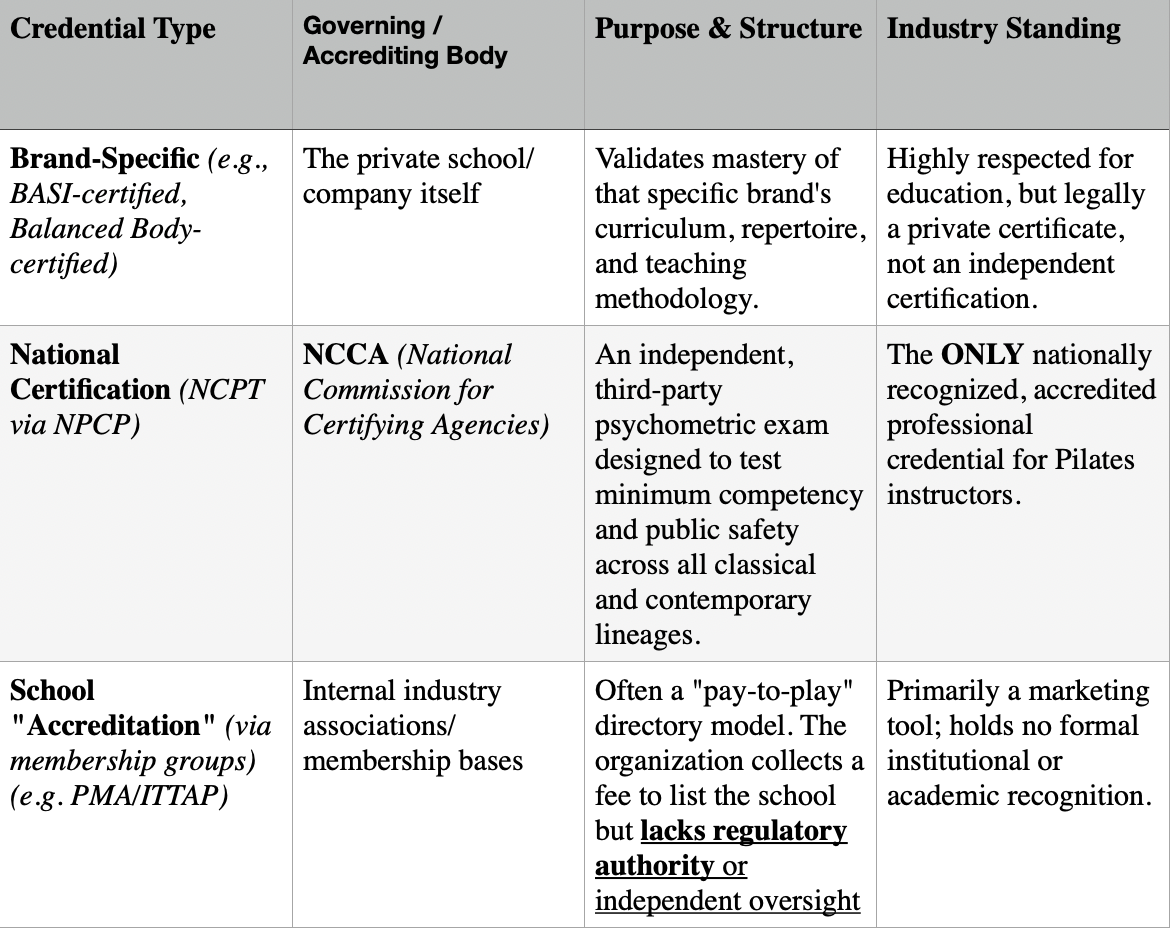
Certificate of Completion: This is an institutional document issued by a specific school or teacher training program (e.g., "BASI-certified" or "Balanced Body-certified"). The hyphen is essential here because the word "certified" is tethered directly to that brand. It signifies that you have successfully finished their specific, proprietary curriculum. It is an internal certificate, not an industry-wide professional credential.
Professional Certification: True certification is an independent evaluation of competency. It is administered by a third-party organization completely separate from the educational entity. In our industry, the National Pilates Certification Program (NPCP) serves as this independent certifying body, granting the credential of Nationally Certified Pilates Teacher (NCPT).
Institutional Accreditation
Accreditation is not something a trade association or a private business can simply declare. True accreditation requires rigorous, independent oversight from an established regulatory body—such as the National Commission for Certifying Agencies (NCCA).
An accredited entity has undergone exhaustive peer review to prove its testing, governance, and organizational structures are completely unbiased and psychometrically sound. In the United States, no private Pilates training school program is NCCA-accredited. Only individual teachers who pass the NPCP exam hold an NCCA-accredited credential.
3. The Legal Purpose of Separation: PMA vs. NPCP
To understand the current friction within Pilates governance, it is helpful to look at why these organizations exist in their current forms.
Originally, the Pilates Method Alliance (PMA) operated as a singular trade association that also housed its own certifying exam. However, a critical legal and structural conflict arises when a membership-based trade organization attempts to certify its own community: true credentialing requires an independent, third-party, unaffiliated organization to eliminate conflicts of interest.
To achieve prestigious NCCA accreditation, a certification program cannot be embedded within a membership trade association. Recognizing this, the testing arm was intentionally spun off into an autonomous entity, which we now know as the NPCP. This separation was a massive victory for the Pilates industry, elevating our status alongside allied health professions like physical therapy and athletic training.
When a trade organization pivots back toward internal "accreditation" initiatives—such as the PMA's International Teacher Trainer Accreditation for Pilates (ITTAP)—it risks reversing this progress. Without the regulatory authority or NCCA backing to act as an institutional accreditor, internal approval structures function primarily as marketing mechanisms or paid registries rather than independent validation.
4. The Real-World Impact: The "Pay-to-Play" Barrier and Student Fallout
When structural definitions become muddled, both training programs and prospective students face real-world consequences.
The Elitist Barrier for Small Programs
The PMA’s ITTAP program charges a significant application fee (frequently around $1,000) simply for a school to be evaluated and placed on an internal "approved" list. For smaller, highly qualified local training programs run by deeply experienced educators, these exorbitant costs are tough to justify. Because prospective students might assume that a program absent from the ITTAP list is somehow less legitimate, this structure creates a "pay-to-play" barrier that favors massive commercial schools over excellent, independent educators.
By contrast, the NPCP maintains a School Verification List designed to help students identify programs that meet foundational training hours and safety baselines, offering a highly accessible path (such as a $25 application fee) to ensure fairness across the industry.
The Impending Fallout for Students
Aspiring teachers often enroll in modular or siloed tracks—such as a "Reformer-only" program—under the impression that the designation carries formal institutional weight. Upon graduation, many face a disheartening reality:
Their certificate of completion may not be recognized by outside clinical, corporate, or university entities that require an independent, NCCA-accredited credential.
They may discover that a modular track does not meet the comprehensive prerequisites (which require a minimum of 450–500 hours across Mat, Reformer, Cadillac, Chair, and Barrels) necessary to sit for the national NPCP certification exam.
Why should a trade organization approve or endorse modular programs that fail to meet the very baseline standards required to achieve national certification? Supporting higher industry standards, transparent teacher training, and robust consumer protection must remain the primary focus.
5. Moving Toward Solidarity and Professional Advocacy
Why does all of this matter so deeply? It matters because building an industry-wide consensus around a single, NCCA-accredited benchmark is the only way to establish true collective bargaining power and professional legitimacy.
Every major fitness sector utilizes accredited certifications. Personal trainers, group fitness instructors, and strength coaches must navigate accredited exams (like NASM, ACE, or ACSM) to hold verified positions in major facilities. When Pilates instructors unite under a standardized, verified framework, the entire industry gains the leverage needed to:
Integrate with Allied Healthcare: Universities, hospitals, physical therapy clinics, and sports medicine centers do not verify legacy or brand names; they verify credentials. Holding an NCCA-accredited title allows Pilates teachers to be recognized as legitimate partners in rehabilitation and wellness.
Lobby for Resources and Protections: Many independent Pilates teachers navigate challenges surrounding fair pay, job security, and access to affordable health insurance. If the industry can step away from internal infighting and rally under a unified governance structure—much like the acupuncture community successfully did to elevate their professional standing—we can collectively lobby for greater systemic support, recognition, and compensation.
Both the PMA and the NPCP have vital, necessary roles to play in our community, but they must stay in their appropriate lanes. The PMA is a critical membership organization designed to cultivate community, offer continuing education workshops, and foster connection. The NPCP is the independent, accredited entity designed to verify schools and certify individual teachers.
When these entities work hand-in-hand rather than overlapping structures, we protect aspiring students, support local education providers, and build a cohesive, respected profession poised for a vibrant future.
For Current Teachers/Studio Owners:
How has navigating brand certificates versus national credentials impacted your own career path or studio hiring practices?
What steps can we take locally to encourage prospective students to seek out comprehensive, verifiable education pathways?
For Prospective Students or Current Student Teachers:
How has the marketing of school programs and navigating the PMA vs NPCP impacted where you've chosen to study?
What do you feel would have helped you understand the industry standards and expectations more clearly?
Did you enroll in a program that you later felt was misleading in their advertisement?